I. "I've tried three times. Nothing changed."
That's how Elena started our conversation.
Eight years as a leadership coach. A loyal audience. A website that never worked the way she needed.
"I just want to understand your situation better," I said. "Would that be helpful?"
She paused. Then she talked for 45 minutes.
II. The fear beneath the words
After three failed attempts, Elena wasn't just frustrated.
She was afraid.
"Every time, they had solutions. Every time, I paid. Every time, nothing changed."
I asked: "What's really worrying you?"
She didn't hesitate.
"That this time will be the same. That I'll waste more time. That I'll start believing the problem is me."
III. "Let's look together. Let's ask the right questions."
I didn't offer solutions. I didn't talk about redesigns or features.
I said: "Can I ask you a few questions about how your site is working right now?"
She agreed.
IV. The questions that changed everything
Me: "When did you first notice things weren't working?"
Elena: "Two years ago. After my second redesign."
Me: "What changed after that redesign?"
Elena: "Traffic stayed the same. But leads dropped. No one was filling the contact form."
Me: "Did anyone check why?"
Elena: "They said it was my offer. They suggested a new program. I paid for that too. Nothing changed."
Me: "Would you be open to showing me the form?"
She shared the link.
V. The invisible problem
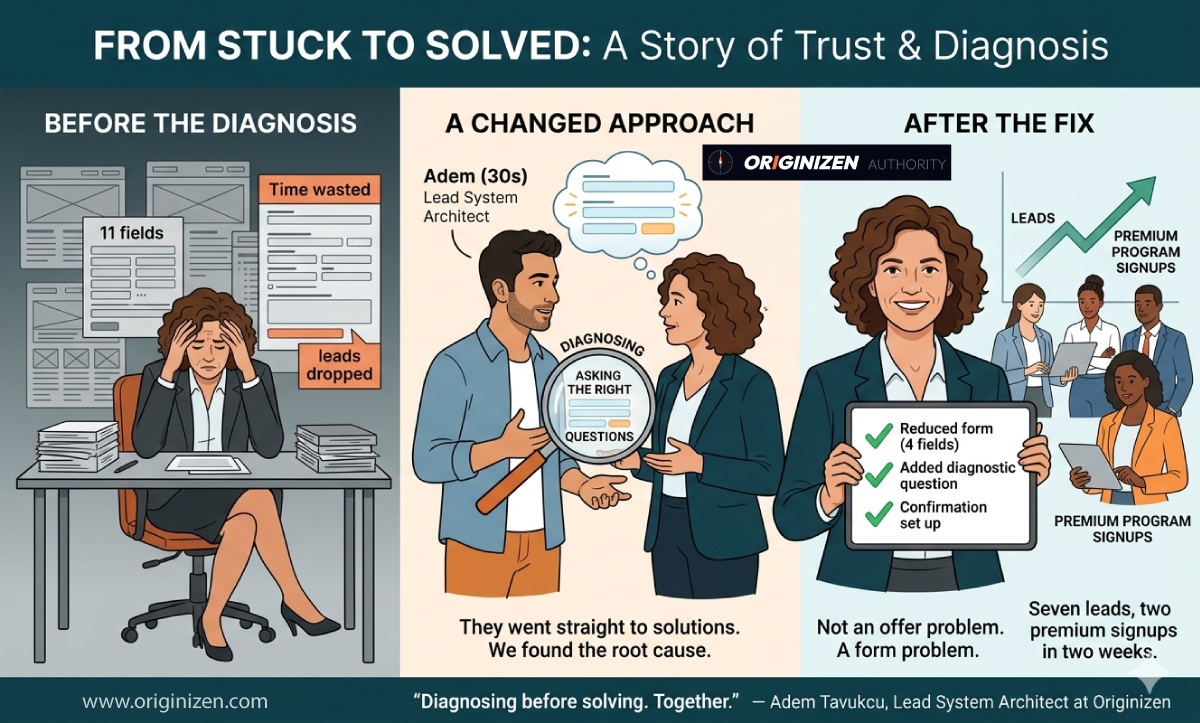
The form had 11 fields. Name. Email. Phone. Company. Role. Budget. Timeline. Message. And three more I can't remember.
No one was filling it because no one had 6 minutes to spare.
But no one had asked Elena to look at the form. They went straight to solutions.
Not an offer problem. A form problem.
VI. "That's it? That's the problem?"
I showed her the data from her analytics. Only 12% of visitors reached the form. Of those, 3% completed it.
She was stunned.
"Three different people. Two years. And no one looked at this?"
I said: "They went straight to solutions. We're here to diagnose first."
VII. The fix. Together.
We didn't rebuild her site. We didn't add new features.
We did three things. Together.
- Reduced the form to 4 fields
- Added a diagnostic question before the form ("What's your biggest challenge right now?")
- Set up a simple confirmation so leads wouldn't get lost
Time spent: 2 hours. Cost: almost nothing.
VIII. What happened next
Two weeks later, Elena sent me a message.
"Seven leads. Two signed up for my premium program. One already paid."
She said something else too.
"I'm not stuck anymore. Not because of the results. Because someone finally asked the right questions before jumping to solutions."
IX. The lesson
Most experts aren't afraid of change.
They're afraid of trying again and getting the same result.
They're afraid of trusting someone who offers solutions without diagnosis.
They're afraid that the problem is them.
It's not.
The problem is the approach.
X. So here's what we can do together
If you've tried before. If you've paid before. If nothing changed before.
Let's not talk about solutions yet.
Let's look at your situation together. Let's ask questions. Let's find what's actually happening.
Then we can decide what makes sense.
What's one thing on your site that doesn't feel right to you?
Building in public. Diagnosing before solving. Together.
— Adem Tavukcu, Lead System Architect at Originizen
READY_FOR_DIAGNOSIS?
The intelligence briefing for What If It Doesn't Get Solved Again?" – A Conversation About Trust is now complete. You have the technical evidence and the strategic context.
Does the Authority Building gap exist in your system?
We analyze your site. You see exactly where your system stands on this topic, what growth gaps exist, and what impact they are having on your revenue — within minutes.

ADEM TAVUKCU
Lead System Architect at Originizen. Specialist in node-based decision engines and operational metabolism. Adem has over 15 years of experience in optimizing remote-first global organizations.

